Showing posts with label Thoughts. Show all posts

Thursday, April 23, 2015

My Teaching Experience

The teaching profession is an honorable, noble and worthy profession. Here is a Toastmaster that shared about her first bout in teaching.

Speech Title: My Teaching Experience


She started by engaging the audience and asked a question of how many wanted to be a teacher when they were young. The audience just responded with giggles and laughter - I suppose teaching was not for most of them but she had some positive responses. She continue to share her about her strong desire to be a teacher during her primary school.

After completing her high school, she had the opportunity to be a temporary teacher in her previous primary school. Initially she felt it was a bit weird because now her former teachers are now her follow colleague. The best was yet to come because her former teachers who had previously punished her before had their kids in her class.

Her first assignment was teaching studies from primary one to primary three. She had initially assumed that it would had been as easy as A-B-C but unfortunately a fear came about - the fear of public speaking and presentation. Time was passing so slowly that she was not sure what to do, then an idea came about - she asked the students to introduce themselves one by one. She discovered that this was one of the favour tactics of teach to pass the time.

She was given tips by her colleagues, and one of the tips was that she needed to put up a fierce front in front of the kids or the latter will ‘run’ all over her. Unfortunately she did not heed her colleagues’ advice and paid the price. She had to regain control and she explained that she brought a cane to class - but that too did not last.

She continues to share the challenges she faced within and out of the classroom. All was not lost, she soon developed her own ways of disciplining the kids. She gave an example of a student who was fond of making excuses to escape certain classes. Finally an opportunity came when she was able to outwit that student.

She concludes the speech that not every teaching experience she encounter was of mess and chaos. There are moments and times when the students truly appreciate and thank her for her efforts. The kids made her feel like a super star.

OBSERVATIONS:
Strengths of the speaker
  • This speaker makes very good use of vocal variety to spice up her speech. She uses varying rate and tone to stress her points accordingly.
  • She also uses hands gestures appropriately to illustrate the action she is verbally describing and she is quite animated.

Some suggestion for improvement
  • I personally felt the conclusion was a bit short and abrupt. Perhaps she can recap on the importance of teachers towards the growth of the children and whether she will do it again.

I enjoyed this presentation very much and had a good laugh. I believe this speaker has a good storytelling skill which she spices up with humour, animated gesture and vocal variety. The message also was an important one for us all to appreciate and understand the teachers that taught us before.


How about you? What do you think are the strengths of the speaker, and suggestions you will give to the speaker? Please feel free to comment below


Disclaimer: The observations above about the strengths and suggestions are the personal opinion of the writer and does not constitute as to what is the right (or wrong) way of presenting a speech or the project intended. The purpose for these observations are for us to be self-aware of our styles, and how we can bring our presentation skills to the next level.

Wednesday, April 22, 2015

Monday Blue

Monday Blues is the lethargic and lack of motivation mood that one feels on a Monday, especially when one has to return to work after a restful weekend.

This speaker shares about what 'Monday Blues' mean to him and this is also a presentation during a humorous speech contest (reference to contest criteria here).

Speech Title: Monday Blues


The speaker attempted to establish a baseline by asking how many in the audience knows about ‘Monday Blues’. To his surprised, not many in the audience responded positively to his question. In any case, he continues his presentation about the different types of ‘Days’ people experiences.

With the classic storytelling opening, ‘Long long time ago’, he continues his story about a dark event that occurred on a ‘Friday’ and the date so happen to be a thirteen (13) which he shared that Westerns will call it a ‘Black Friday’. This is somewhat opposite to how people will feel about a Friday as it is typically the last day of a working week - happy. Fortunately there is a restaurant that will serve you whether you’re feeling dark or happy and that is “Thank God It’s Friday” or commonly known as TGIF.

His presentation proceeds to talk about Wednesday. In Malaysia, usually on Wednesday the local cinemas will have weekly promotion and movie tickets will be at a discounted rate. He continues to elaborate that on Wednesday the ladies will be given extra benefits when they frequent bars and clubs because of ‘Ladies Night’

‘Saturdays’, what can one say about ‘Saturdays’? He shares that ‘Saturdays’ can be refer to as ‘Green Saturdays’ because certain the states in Malaysia encourage traders, hypermarkets and shops not to provide plastic bags, and for shoppers to bring their own recycle bags.
Next he brings his story back to ‘Mondays’. He wonders why it is called ‘Monday Blue’, and start to analyze and discuss the different possibilities on why it’s called ‘Monday Blue’.

At the conclusion of this speaker’s presentation, he presents his overall case on why people call Mondays, ‘Monday Blue’. He stresses that whatever a day is called, it is still our respective choice on how we should feel and act – and that choice should be a positive one.

OBSERVATIONS:
Strengths of the speaker
  • The speaker uses questions and anecdotes to attempt to connect to the audience. When successful, it will help the audience to understand the message the speaker is attempting to deliver.
  • The speaker does have purposeful body movements to express the mood his is trying to portray, for example when he stated ‘Strong’, he stood firm with his chest out.

Some suggestion for improvement
  • The speaker tends have quite a number of ‘pause fillers’ in his delivery. ‘Pause Fillers’ are words such as ‘er’, ‘ah’, ‘em’ ‘lah’ - words that does not add any value to the speech but rather may distractions. It is recommended to use a silent pause if one needs to think of what to say next.
  • The speaker tends to apologizes when he does not get the reaction he expects. A speaker should not need to feel the need to apologize but rather continue to be confident in the material he is delivering and complete the delivery as smooth as possible. After the speech, one can analyze to see how one can improve in the future.
Generally the speaker has a lot of potential, and with his animated and humorous skills will allow him to deliver his messages in a fun and easy going manner that will be easily remembers by the audience. I enjoyed this presentation fully.


How about you? What do you think are the strengths of the speaker, and suggestions you will give to the speaker? Please feel free to comment below


Disclaimer: The observations above about the strengths and suggestions are the personal opinion of the writer and does not constitute as to what is the right (or wrong) way of presenting a speech or the project intended. The purpose for these observations are for us to be self-aware of our styles, and how we can bring our presentation skills to the next level.

Tuesday, April 21, 2015

Thumb Driving


This presentation by this Toastmaster is different from the initial two (i.e. 4 Misconceptions and FindRecycler) because this is presentation is for a humorous speech contest. There are no specific objectives to be met but there are judging criteria that judges uses for giving marks. Please refer to the ‘Toastmasters Judge’s Guide and Ballot’ below.

Speech Title: Thumb Driving


The speaker starts off confidently with the basis salutation. He states a belief that,
“Skills are developed when you do something repeatedly”.

He proceeds to elaborate on a skill that he developed while being behind the wheel (car) and in a traffic jam, which he calls ‘Thumb Driving’. There are apparently three variation of this skill.

The first variation, ‘Two thumb driving skill’ - by just placing both thumbs on the steering wheel and drive. He made sure he evaluates his driving skill by gathering feedback from his passages, by asking them “if he had driven them to the place safely?” or “if he had driven them insane?”. He proudly declares that he will get a rating of ‘two thumbs up’.

The second variation, ‘One thumb driving skill’ - he illustrates this variation by mimicking his single hand on a steering wheel with his thumb extended and drive. This variation allows the driver to have one hand free to do whatever he wishes. In a humorous manner, he provides examples of what can be done with the free hand.

The third variation, ‘No thumb driving skill’ - this skill uses the remaining fingers while relaxing the thumb. This variation allows the driver to hide part or all of his face (quite similarly to a boxing technique called ‘Peek-a-Boo’), but he nicknamed it as ‘Hiding from the wife’.

He concluded his presentation with an important message about driving safely; that we should prepare our minds with the right mindset and put away any possible distraction so that we can focus on reaching our destination safely.

OBSERVATIONS:
Strengths of the speaker
  • This speaker is a very animated individual who is comfortable to use his overall body purposefully to enhance his speech. Look out for the part where he lets his hand do the talking.
  • He uses pauses appropriately to allow for the audience to absorb what he is saying and react (laugh).
  • The speaker was able to compose himself and recover appropriately after he encountered a momentary lapse in memory.

Some suggestion for improvement
  • Equal allocation of time for each point. The second point that the speaker was illustrating were allocated a lot more time compared to the first and third. 
  • More practice will allow the speaker to share his message more smoothly and avoid any lapse in memory.

Generally the speaker has a lot of potential, and with his animated and humorous skills will allow him to deliver his messages in a fun and easy going manner that will be easily remembers by the audience. I enjoyed this presentation fully.


How about you? What do you think are the strengths of the speaker, and suggestions you will give to the speaker? Please feel free to comment below


Disclaimer: The observations above about the strengths and suggestions are the personal opinion of the writer and does not constitute as to what is the right (or wrong) way of presenting a speech or the project intended. The purpose for these observations are for us to be self-aware of our styles, and how we can bring our presentation skills to the next level.


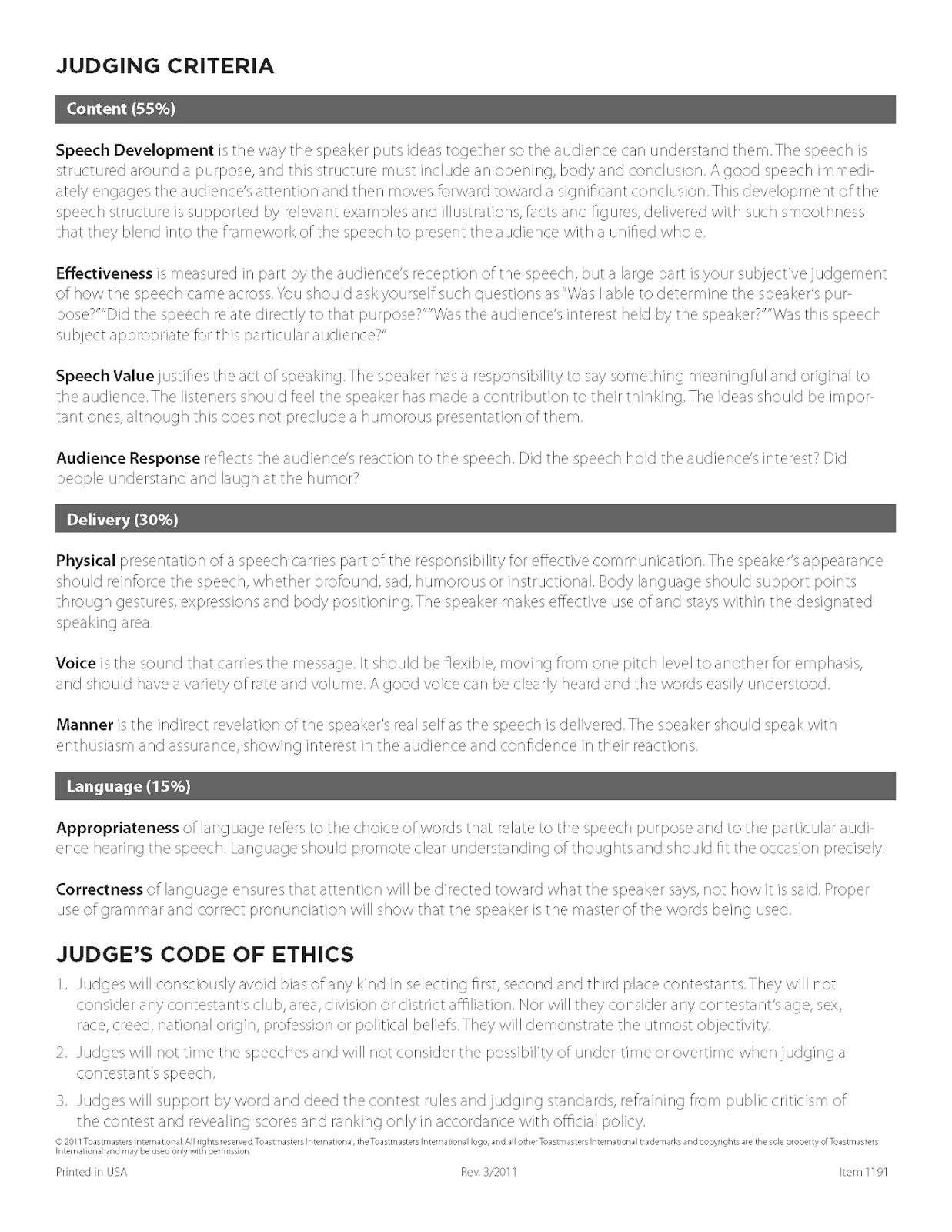


Here are the Judging Criteria extracted from the Toastmasters Judge’s Guide and Ballot

Judging Criteria

Content (55%)

Humorous Speech Contest Judge's Guide and Ballot pg1
Speech Development is the way the speaker puts ideas together so the audience can understand them. The speech is structured around a purpose, and this structure must include an opening, body and conclusion. A good speech immediately engages the audience’s attention and then moves forward toward a significant conclusion. This development of the speech structure is supported by relevant examples and illustrations, facts and figures, delivered with such smoothness that they blend into the framework of the speech to present the audience with a unified whole.

Effectiveness is measured in part by the audience’s reception of the speech, but a large part is your subjective judgement of how the speech came across. You should ask yourself such questions as “Was I able to determine the speaker’s purpose?” “Did the speech relate directly to that purpose?” “Was the audience’s interest held by the speaker?” “Was this speech subject appropriate for this particular audience?”

Speech Value justifies the act of speaking. The speaker has a responsibility to say something meaningful and original to the audience. The listeners should feel the speaker has made a contribution to their thinking. The ideas should be important ones, although this does not preclude a humorous presentation of them.

Audience Response reflects the audience’s reaction to the speech. Did the speech hold the audience’s interest? Did people understand and laugh at the humor?

Delivery (30%)

Humorous Speech Contest Judge's Guide and Ballot pg2
Physical presentation of a speech carries part of the responsibility for effective communication. The speaker’s appearance should reinforce the speech, whether profound, sad, humorous or instructional. Body language should support points through gestures, expressions and body positioning. The speaker makes effective use of and stays within the designated speaking area.

Voice is the sound that carries the message. It should be flexible, moving from one pitch level to another for emphasis, and should have a variety of rate and volume. A good voice can be clearly heard and the words easily understood.

Manner is the indirect revelation of the speaker’s real self as the speech is delivered. The speaker should speak with enthusiasm and assurance, showing interest in the audience and confidence in their reactions.

Language (15%)

Appropriateness of language refers to the choice of words that relate to the speech purpose and to the particular audience hearing the speech. Language should promote clear understanding of thoughts and should fit the occasion precisely.

Correctness of language ensures that attention will be directed toward what the speaker says, not how it is said. Proper use of grammar and correct pronunciation will show that the speaker is the master of the words being used.

Monday, April 13, 2015

4 Misconceptions

Speech Title: "4 Misconceptions"


This Toastmaster is attempting the Competent Communicator project #5: Your Body Speaks (click here for the objectives).


In this presentation the speaker shares about 4 misconceptions of successful people adapted from the book “Piano on the Beach” by (the late) Jim Dornan.

His starts off confidently by engaging the audience and established interest by asking the audience if they had read the book. Apparently the audience replied that they have not, hence gives him the due attention.

He then proceeds to elaborate that the book speaks about the 4 misconceptions that people generally have about ‘Successful People’.

Misconception #1: Successful People are Talented and Gifted
He proceeds to give an example with a simple enactment of what people assume and say when they see a successful person. By assuming that the other person is born talented and gifted, the one assuming has already put him/herself at a disadvantage (unnecessarily). The speaker shared his experience from his schooling days where students were asked to state their ambition - expanding on it he states his beliefs that strong desire can outweigh talent.

Misconception #2: Successful People have better Opportunities or better Circumstances
For his misconception, he gave various examples such as difference in wealth (i.e. rich and poor), difference in education background, and difference in age. To break this misconception, he shared about the success of Bill Gates at a tender age and also Colonel Sanders who achieve success at his senior years.

Misconception #3: Successful People are Lucky
Quoting an example of someone who constantly wins the lottery he elaborates on this misconception. He shares that the initial effort, constant hard work and being appreciative can overcome this misconception. Passion and self-belief is also another plus point.

Misconception #4: The misconception towards oneself
This point is about losing confidence and allowing the other misconceptions to break down your own self-confidence. To overcome this, his shares about taking one step at a time and also to pick yourself up after each failure.


The speaker concludes the presentation with a call to action for the audience to start dreaming, believing, and planning their respective journey to the top.

OBSERVATIONS:
Strengths of the speaker
  • The speakers comes up and takes center stage confidently.
  • He is able to use his hand gestures purposefully to show transitions for example when he said 'Moving Forward' - he shifted his hands from left to right, convention gestures for indicating direction, and descriptive gestures for example small to big.
  • He has a good speaking rate, uses pauses, and dialog to illustrates some of the examples given.
Some suggestion for improvement
  • For this project, Your Body Speaks also calls for the use of the overall body and facial expression.Throughout the speech the speaker had mainly a pleasant smile and cheer - which is good, some variety may be better. For example during the instances where he was giving examples, when a person is downcast and discouraged, and he believes he is at a disadvantage - the speaker could illustrate a sad and demotivated facial expression.
  • The speaker could have used have use the speaking area (and body) to his advantage. For example, instead of using his hands to illustrate 'Moving Forward', he perhaps can take two steps forward.
Generally the speaker has a lot of potential, and is able to project himself confidently and delivered the message he intended. A bit more practice will allow the speech to be more fluent and avoid the near miss of forgetting his point.


How about you? What do you think are the strengths of the speaker,  and suggestions you will give to the speaker? Please feel free to comment below.


Disclaimer: The observations above about the strengths and suggestions are the personal opinion of the writer and does not constitute as to what is the right (or wrong) way of presenting a speech or the project intended. The purpose for these observations are for us to be self-aware of our styles, and how we can bring our presentation skills to the next level.

Sunday, June 17, 2012

Global Crisis, and Regional Social, Political & Economic Development

As I continue to progress and development my project management career & knowledge, I personally understood and believe in the importance of Communication Management, more specially towards Stakeholders Management (it is one of the progress groups in the PMBOK after all). However the recent first MSCPMP Half Yearly organized by MSCPMP Circle was a real eye opener.

In project management we often take care of our project (internal / direct) stakeholders, however how many of us take the extra steps to identify and understand the external stakeholders that also affects our projects. A lot of us including myself often declares "I don't care about politics ..." or "I hate politics ... I just wish to deliver my project(s)", however, politics does have a direct and/or indirect effect to the projects.

This session below shares with us the importance of seeing the 'much bigger picture' that has a direct or indirect effect to our projects.

MSCPMP: Global Crisis, and Regional Social, Political and Economic Development by Dr. Oh Ei Sun


As I sat through this session, I took a few glances around the room of more than 300 plus project managers; there were those who were engrossed towards what Dr. Oh sharing, and there were some decided to catch up on some much needed rest. Now the topic itself can be interesting or it can be not-so interesting as it depends on what you are looking for. For me, as I mentioned it was an eye opener and as I wish to continue to increase my exposure, it look for to more talks like these.


Cheers.

Sunday, October 16, 2011

The Titles We Bare


(video posted with the Speaker's permission)

Script:
When we were born, we were bare, naked and without possessions. Then we were given our first gift, a Title, our names.


Point #1: Among family and friends

Positions in the family can be term as titles. As the first born and a son, I was the ‘Pride of the Family’, … till my two brothers came along.

Who among you are the eldest siblings? {Raise your hands}

How many of you receive this instruction from your parents before?

“You are the eldest in the family, so you need to set a good example to your brothers and sisters!”

I heard that a lot of times from my parents, but every time I heard that, I’ll be wondering; “Who’s my example?”

Sometimes my parents would exclaim exasperated in “Aiyah … Don’t know where he learn to do that !?!??” I in my head I’ll be shouting “Aiyah … from you loh” … obviously I won’t be saying out loud unless I want to receive a ‘five finger wave’ (slapping action) … so parents, be careful of what you say and do in front of your kids.

The Titles We Bare in family positions can come great responsibilities and sometimes great pain.


Point #2: In our Working Lives

I started working more than 10 years ago. That’s when I was expose to Organizational Titles; Junior Executives, Senior Executives, Managers, President and so forth.

Fame, Money and Power, are some of the driving forces for us to gain titles, do you agree?

The greater, higher, and more glamorous sounding titles, the great the perceived remunerations.

Not only the remunerations but the kind of treatment we receive. For example

When I do something without being told,
I am trying to be smart,
When my manager does the same,
he takes the initiative,

When I am sick, on Medical Leave,
I am always sick.
When my manager is a day off sick,
He must be very ill.

When my manager applies for leave,
it's because he's overworked
When I apply for leave,
I must be going for an interview.


Point #3: In Toastmasters

Let’s bring this topic closer to home. In September 2005, I stepped into my first Toastmasters Club, D’Utama Toastmasters Club.

As I sat through the meeting the acronym & titles started flying around, CTM, ACB, GE, and DTM – to name a few. Needless to say that I’d joined the club later found out that those were the titles we earn as we go through the communication and leadership education program.

CTM – Competent Toastmasters,

It was in 2006 I heard that Toastmasters International was going to change the for the Communication track award titles, ‘Toastmasters’ was going to be changed to ‘Communicator’ to be more specific to which track the award is for.

When I heard this and found out what the new abbreviation was, I was filled with fear … WHY? Because the new title will begins with ‘CC’ …

What’s wrong with ‘CC’ you ask?” Well it sounds like ‘sis-sy’ … and the meaning of the title does not do justice because ‘sis-sy’ means ‘timid or cowardly person’ … unlike ‘Competent Toastmasters’ …

Which one sounds better ‘Johnson Yike CTM’ or ‘Johnson Yike, CC’?

I rest my case and decided to work very hard to complete my 10 basic speeches and gain my Competent Toastmasters award.

Throughout my journey, I meet many confidence, compose and charismatic Toastmasters. They were humble and shared their experience, knowledge and wisdom freely. Unfortunately there were some who were just in it for the glory, and demands respect. They confused the corporate world with the ‘sharing and caring’ environment.

Some when they gained their Advanced Communicator Bronze, ACB … they perceived it as ‘Alright Can Boast’ … “what title are you ah? Oh, CC only ah … I ACB wor (I better)” It’s when they come face-to-face with a DTM then they keep quiet. Then they will scramble to rush through the program to get their DTM to feed their ego again.

The Titles We Bare in results may affect the Treatment we receive.


Conclusion

Personally for me, do agree that titles plays an important role … it helps is to gauge our progress in whatever we do. However, those titles are given by people and it could also be easily taken away. What is important is true meaning behind the title and how it helps you to reflect in your heart.

At the end of it all, all of us will receive the same title. R.I.P. .

Steven Covey teaches us to ‘Begin with the End in Mind’.

Generally it means ‘Rest In Peace’ but sometime even when one is gone, there is no peace because of the legacy that was left behind. So ladies and gentlemen, let us not be so caught up with titles and continue to do what is good for the betterment of all. Be a good son/daughter, be a good employee/manager, be a GREAT Toastmaster.

The Titles We Bare affects our legacy.

So that when we go, we will be according this unofficial title, ‘Remembered In Praise’.

Wednesday, August 17, 2011

In The Beginning...


TheProVoices Logo
The Objectives of this site;
  • To PROvide acknowledgement on the efforts of Personal and/or Professional development.
  • To PROvide Encouraging, Constructive and Empowering personal feedback and evaluation.
  • To PROvide a Source of Reference.